Sermon on Abraham, for 28.6.2026
Abraham is a character always on a journey. He’s a figure revered in various ways by a number of faith traditions who, tragically have not yet fully allowed themselves the blessing of peace between neighbours.
Though in sharing an Abrahamic heritage, they do have that opportunity.
Nothing bad is ever settled. That’s the cause for hope.
So not even as an elderly father and tribal leader, is Abraham other than a work in progress. We are told that God tested Abraham.
Is this the curriculum God puts him through – whether he still has that crafty adaptability?
Or is the problem – and there certainly is a problem here- that Abraham has settled into a practice of blaming God for the decisions, good or bad, that he’s inflicted on his community.
A God who otherwise has a habit of saying why rather than just demanding blind action.
Was that why, as we’re told, God decided to “test” him; remembering that it’s through testing that we are qualified.
A couple of weeks ago, if you were following the lectionary, you might have heard of the graduation, of Abraham and Sarah as people upholding the most ancient survival skills of any human society, namely of hospitality to strangers in need of shelter and refreshment, when Abe and Sadie ran around and thoroughly pampered the three travellers who, somehow were God; offering bread, but serving cakes [that one was worth looking up!]. No problem there.
But as we encounter him today, a few years later, he’s more isolated in his faith: the ‘young men’ of his community are not religious adherents, just farmhands, or something similar, who leave their elderly boss to his strange religious stuff. A faith he tells no one about. So that faith isn’t tested by his community.
Is he embarrassed that his special god turns out to be just another of those many callous gods who need to be placated. So unlike the God he’s told them of.
Abraham himself is not yet Jewish: – it’s his grandson Jacob, the wrestler with God, who will thereby earn the name Israel. The key aspect, then, of any heritage which talks religiously of “Israel” even as does Christianity, is the vital readiness to argue with how God looks to you.
Even and especially when God – as you imagine God has to be- looks to be a threat to you. A threat To justice. To beauty. If God looks that way: remember, this is a test!
I think that one of the scariest moments I’ve had to think about this year was a conversation in January, when I’d just delivered the “Time for Reflection” in the Scottish parliament, when one of the MSPs, who doesn’t themself have a religious background, came and had a chat about the people in politics who’d been bandying around the masquerade of “Christian values” .
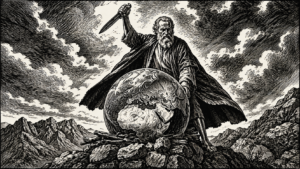
Which were clearly very far from hospitality, welcome and refreshment; far from the lovely Celtic Christian tradition of Christ in the stranger’s guise. Far from the diversity which as we revisit the Creation stories of Genesis 1 and 2, comes through as the wisdom of God. Not the values of Christ, but maybe the values Abraham thought he was pursuing, knife in hand, before the angel stepped in.
But unless Christians speak up, they will hog the stage, and build barriers of suspicion against the lovely influence of Christ
In Abraham’s defence: For much of his life in the Bible, Abram’s a refugee – on the move, living by his wits, without the luxury of squeaky-clean honesty that might be open to someone living peaceably and without threat.
Perhaps we might turn to Jewish legends too, to cast light on his forced and abrupt departure from what appeared to be the abusive religious background of his family and native land; Even from Biblical evidence alone, the story – as we have it – is one of someone with a traumatic background, gradually learning to know and trust God, rather than joining a defined religion or faith group.
So he starts with a perception of a promise, that God will make him a blessing to all the families of the Earth – in which I think it’s perfectly reasonable to include families beyond the human. That promise is fulfilled in the devotion and initiatives of Christians around the world who delight to see care for Creation as the cake not the icing of our faith. This is a path, begun with Abraham’s departure from home, which leads to the justice which is good for the Earth.
We’re told – and this is what made him the cover-boy of the European Reformation – we’re told that Abraham trusted God, and that for God, that trust was as good as being good. He was, in that opaque church language “justified by faith”.
Perhaps an illustration to make that sound less contradictory. To help us understand what it means to be faithful, but without security.
I was at a meeting in Dublin a few weeks ago, looking at an interfaith approach to welcoming the stranger, as it were. And we heard from an inspiring and highly educated woman, a refugee from Afghanistan, who had used her skills and knowledge to forge documents which had helped others sharing her predicament to escape the oppressive dangers of the regime. We applauded, warmly. Justified in her transgression of law, by her love for fellow people.
Now… way back, if anyone asked about the Abraham and Isaac story, you could fall back on a Victorian Sunday school version of things and say that this is a story given us to help us grasp the awesome magnitude of the self-giving of God in Christ, like a father giving up his son. And you could commend Abraham for his extreme obedience.
But in the original writing down and telling of the story, there is a lot more going on, including the heavyweight rejection of human sacrifice by the religion of Israel. That a God who endorses abuse cannot be worthy of worship.
Even though elsewhere that sort of sacrifice still carries the clout of the right thing to do.
Call yourself a god if you don’t want blood?
That attitude hasn’t yet been let go of. Not now. Not in the last century, by those proud older generations, who as the war poet Wilfrid Owen observed, did not
“Offer the Ram of Pride instead of him.
But but slew [their] son,
And half the seed of Europe, one by one.”
And that’s one of the powerful themes for our day and age.
The things we either proudly or conscientiously think we have to do, including those confidential burdens, which, like Abraham, we cover up with lies, though as it turns out, the lies he told his son, of a God who provides what is needed for what God requires; that turns out to be the truth.
About a God whose habitual communication comes with reasoning why, rather than a dictator’s demand for absolute blind obedience. Pushing us into “The things we think we have to do.”
I have seen something of this in recent years, and with dimensions very relevant to my mission as environmental chaplain, working with churches who have benefitted both from investments in the oil and gas industry, which my friends in the world church have very amply pointed out, causes misery and suffering, as also historically, from the transatlantic slave trade. In the verbatim words of an elder at my first church, back in the nineties “it may not be Christian, but we have to do it!”
In recent memory, the perceived fiduciary duty of church trustees was seen as only to maximise monetary assets.
Even if this meant sacrificing the aims and objectives of the church itself, perhaps as visibly expressed in fair trade products, or the retention of a community facility.
Or more recently, pulling back from the expression of mission, witness, and discipleship in measures to reduce the carbon footprint of the community we might call a church.
And even though the law has formally eased in the narrowness of that defined duty, I suspect Abraham might be that sort of grimly meticulous trustee.
Burdened by the shackles of a conscientiousness they’ve perhaps had to defend over many years, where trustees sincerely believe they’re guardians rather than custodians of the assets of faith.
Just a mile from here, there’s the memorial to Lord Melville, whose interventions succeeded in delaying by some years the end of the slave trade, with an insistence, just like what I read in an email from an MSP, on change happening “gradually, sensibly, eventually”, rather than, for the good of all, as urgently and justly as possible.
Yes, as we respond to a far bigger crisis than most people in the UK realise, there are sacrifices ahead, but for God’s sake let them be the right ones.
The rams of oil, not the children, not the wildlife, not the farming, not the tourism. I could go on and not come close to exaggeration.
But that phrase “drill baby drill” is so blatantly sacrificial; ‘kill babies, kill” is what it results in, along with all the other vandalism of efforts towards transition.
As that MSP in January noted, Just now, politicians who bandy around the name of Christ are also demanding new oil and gas exploration, knowing full well that this kills and evicts our neighbours, human and otherwise.
Given the freely available scientific evidence, beyond reasonable doubt, of the global harm fossil fuels are already inflicting, such public figures do not deserve the defence open to Abraham, that he is acting, conscientiously, in the dark.
Taking upon himself, in isolation, what he believes to be a terrible but inevitable duty.
Oil and gas, conspicuously worse investments than renewables, have now become the preserve of the most incompetent capitalists
Meanwhile, what we hear from sisters and brothers in the Pacific and African churches -what I’ve promised a sister from the church in Pakistan to tell you – is that the unprecedented disasters of nature are not natural, nor do they happen without chains of responsibility.
“But we have to do it” Do we?
Abraham tries to cope by lying. We see Abraham in this story lying and deceiving those he loved, and those who were dependant on him.
To the servants, he says: “we will both be back.”
To Isaac he says: “God will provide a sacrifice”
What does he say to himself? How does he feel?
Ironically, it is in his lies, that Abraham shows his better and more hopeful self. We will both be back. He lies. God will provide. He lies.
Abraham is prepared to share a God who is to be worshipped.
He is prepared to share a God to whom it is right to offer sacrifice.
But the God he keeps to himself is the twisted god who craves Isaac’s blood.
Abraham, therefore, knows already in his heart of hearts that the God that would go all the way to sacrifice someone else’s son must not be shared or praised.
And indeed this is what he discovers.
That God cannot be praised by violence or injustice
And was anyone ever so glad to be wrong?
AMEN