
All Saints- at Aberdeen United Reformed Church
Download PDF HERE
WRITING AS ECOCHAPLAIN, WORKING ECUMNEICALLY, FOR A UNITED REFORMED CONGREGATION.
Suggested Clip= edited version of “Blessed are the cheesemakers…. Life of Brian “[A send-up of the Hollywood reading of the Sermon on the Mount]
Monty Python, swallowed, without further ado, the way Hollywood- but also some enthusiastic churches- may have heard or even read our Gospel reading- about what it takes to be saints, to be “blessed”.
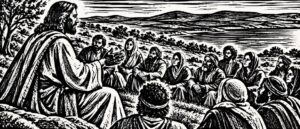
About the Sermon on the Mount – which is our record of Jesus’ course in sainthood.
Perhaps we’re equally seduced by prestige implied if take this to be what he said to the crowds, yet we read that when crowds gathered, he cleared off uphill, and those, who then went out of their way, were the ones who received this teaching, intimately, face to face, eye to eye. Not the crowds, along for the jolly ride, were the saints, but this huddle on the hill. Receiving not just a sprinkle, but an immersion of teaching. Of Communion.
That’s one of the gifts of such smaller gatherings as this: the vulnerability and intensity of not being able to hide in that crowd. The crowd which always risks becoming dough without yeast.
In talk about the saints of the church; to stick with images of bread making: if disciples are yeast in the dough, then even yeast needs to be activated. By getting together, by nourishment, by worship, by Communion.
On those occasions when I visit Aberdeen, whatever the brand of church, I know that you live in a city which has come to rely on industries which, for the sake of the planet’s health must urgently – but also justly – come to an end.
That when, as environmental chaplain, I’m obliged to look, and pray, for a just transition away from fossil fuels, I know there are good folk in this city who prefer to hear neither of the urgency – nor of the love for our neighbours – which that change of heart and mind involves. And yet more oil does more harm. That’s what I’ve learned.
On that -as Martin Luther reputedly insisted, even under immediate threat from the authorities of his day -here I stand, I can no other.
Today, that we hear of “All Saints Day” remains perfectly in order for a Reformed Tradition congregation, for whom our fellowship with the whole church in heaven and Earth – indeed throughout Creation, is formally mainstream.
Our traditions also encourage our gratitude to and for those ‘faithful departed’ we have loved and shared with. Those now in God’s closer care. The ‘cloud of witnesses’
As in Hebrews: “ Therefore, since we are surrounded by such a great cloud of witnesses, let us throw off everything that hinders and the sin that so easily entangles. And let us run with perseverance the race marked out for us, fixing our eyes on Jesus, the pioneer and perfecter of faith.
Today comes in a calendar weekend on which a huge amount has been hung by differing interests .
If I were to insist on my Reformed Church hat, then yesterday was Reformation Day – and it’s interesting how many churches who might think of themselves as “protestant” are oblivious of this.
The day when, piggy-backing the eve of All Saints, Martin Luther posted a discussion document raising 95 constructive criticisms about how his own beloved church was being run.
And though yesterday was that “Eve of All Hallows”, a detached observer might identify it as a festival in which the aim is to accumulate, then throw away as much plastic as possible. That’s a fairly devilish practice in itself. Environmentally and otherwise.
Yet amongst the Christians I encounter, it’s not the plastic, but a more stubborn and peculiar fear that the acknowledgment of Hallowee’en, even with its more interesting folksy links to a traditional Lammas and Samhain might result in some sinister waywardness which they’ve often branded ‘pagan’; the fear that it might endanger your faith.
Though in a multi-faith culture, there are far far worse things, worse idolatries than your kindly neighbour’s idea of God.
And it need not damage -indeed it strengthens our own faith – to acknowledge, even as did our earliest Christian ancestors in Scotland, that God is big enough, small enough and flexible enough to be at work beyond our own preoccupations.
My studies on the life of Saint Columba confronted me of his encounter with Arbranan – a man described as a ‘saintly pagan’. Subsequent editors and translators haven’t quite managed to erase that description.
Reminding us that faithfulness to Christ will often involve “dirtying our hands” – as Jesus’ own people would have seen it, with people of goodwill . Foreigners and worse. Jesus wasn’t bothered.
There is, meanwhile, nothing remotely saintly in the way in which Christian Nationalists, even in Scotland today, abuse the Cross of Christ to justify the hatred of “Christ in the stranger’s guise”. Contempt for refugees, though Christ, as a child, was himself a refugee.
Because it’s not in some remote verse of an obscure minor prophet, but in this Sermon on the Mount, from which our Gospel today is also drawn, that Jesus insists that just waffling about him is not sufficient to qualify as on the path to sainthood:
“”Not everyone who says to me, ‘Lord, Lord,’ will enter the kingdom of heaven, but only those who do the will of my Father who is in heaven” …Then I will declare to them, “I never knew you; go away from me, you evildoers.”
As, at this time of year, the United Nations climate conference also approaches, I’m reminded of how, for COP26 in Glasgow, there was a saintly gathering in George Square where Christians of various shapes and sizes were joined by saints of different pathways: Muslims, Hindus, Sikhs, Ba’Hai, Jews, Buddhists and of course also pagans recognising that a spiritual commitment has value to the extent that it encourages care for the Earth, and thereby fellow humanity.
At the end of the resource I’ve offered for EcoCongregations to follow COP this year, I have made a prayer of a quote from the Multi-faith Declaration signed by all the groups who took part:
[Dear God, we lift our hearts to you, mindful that….]
…across our doctrinal and political differences, we know that we must change our ways to ensure a quality of life which all can share, and we need to provide hope for people of all ages, everywhere, including future generations. AMEN.
On All Saints day, can we grasp that saints are those who make connections. Of love, of justice. Not just with fellow people, but as we can see in so many foundational stories of our cities and nation, with fellow creatures and with the Earth too.
That said, Saint Nicholas of Myra, the Turkish Christian who, as patron to seafarers, gives his name to this building is unique because his primary legends feature almost no animal miracles.
I don’t have to be preaching in Roslin Chapel to be reminded – because the Bible makes it pretty clear -that the ‘Communion of Saints’ always nestles within a ‘Communion of Creation’. The stories of saintly Christians interactions with birds and animals are there not just as decoration, but as authentication of their sanctity. Saints are a connected people. As Christ incarnate in the Earth is connected with Creation.
Dig into the name the Bible has given to the opposition to God – devil or diabolos– and you find it means the one who dis -connects, who tears apart, rather than unites and reconciles.
This is the power against which those thousands struggled, in the Revelation vision, who also suffered rather than inflict suffering. Both in the vision and in Jesus’ formal teaching, the Blessed are likely to have been persecuted. The Blessed do not persecute.
Given our own cultural legacies of colonialism and conquest, I have to add a further reservation when we read Revelation: that, in John’s fevered vision of those gathered and dressed in white, all of them are nonetheless still recognisably “from every nation, all tribes and peoples and languages,”.
This is in no sense a uniform indeed, the robes of different nations will vary as much as their faces, but rather -in John’s vision – this a sign of common, intimate, involvement with Christ, with the “Lamb” who is themself not discarded by God as a means to an end, but actually seated on the throne.
The unity God offers is always distinctively in diversity: from the abundant variety of Creation onwards, through the overthrow of the deadly uniformity of the city of Babel, to the birth of the Church at Pentecost, where the gift of the Spirit to the saints was not the imposition of their own tongue, but the ability to communicate interactively with others. Negotiation, not eradication.
To remain ourselves whilst realising that that this self God gives is unique, and valuable and also a work in progress. We follow a Saviour, a Messiah, a Christ whose first call, whose first lesson to those who would be saints, is to ‘repent’ – that is, more closely and less churchily translated , to “change your mind”.
Why, then should it be a surprise that scientific disciplines have finally concluded, with the motto of the Royal Scottish Zoological Society, that “Biodiversity is the wisdom of God”. Biodiversity is vital to the health of the Earth.
But the worship of Money power, and national identity above all, coupled with the unjust misuse of natural resources:- these are far greater spiritual threats to the company of the faithful – to “the saints”, than a knock at the door from children dressing up.
The saints, who in the Bible – by the way – are only referred to as a community rather than as isolated individuals. “Contribute to the needs of the Saints”, says Paul in his fund-raising letter to the church in Rome, who, themselves had already experienced official persecution by the time he wrote.
And after three decades in ministry, I’d rather say that Halloween – and especially the less trashy Scottish and Celtic traditions it’s built on -can be a helpful exercise in preparation for the darker experiences of real life.
Something which the nervously shallow movement to hold a “light party” for children doesn’t grasp.
Tomorrow, we have the further option of the rather gentle Feast of All Souls, emphasising God’s love and care for those many friends whose lives were lived, perhaps imperfectly, yet still as the ‘faithful departed’ enfolded in the love of God. They may not have been saints. But it’s the job of the saints to love them, to give thanks for them. And all that they, knowingly or otherwise, have shared ands will share of the love of God, who calls us together in the sharing of Bread and Wine.