Christ the King Sheep and Goats Mattew 25 Priesthill
A Dose of Reality
‘Sheep and Goats’ – Matthew 25
Churches talk a lot about “Kingdom”. But we don’t always unpack it. We pick ‘Kingdom’ up from the use of a particular Greek word, Basileia, (βασιλεία ) in the New Testament. Which can mean ‘kingdom’ or ‘reign’.
In my work as Environmental Chaplain, I’ve noticed that there’s – sometimes – a distinction between the Kingdom of Heaven, or of the Skies, which refers to the way things are, and is fragile, vulnerable, and in need of care and healing…and the Kingdom of God, which refers to the way things should be, ought to be: and God willing, will be, and of which we are gifted glimpses now and then.
The Kingdom which is God’s, by right. Which, as long as God is Good, seems worth looking forward to, or even, at the least, as it has been over centuries, a nourishing encouragement with what we’re up to our eyes in today.
That’s the kingdom which the “sheep” depart into at the end of the story – and guess what? -they go there not as sheep, not as underlings and nobodies, but each and all of them, as rulers, as kings, or maybe, as something rather better.
In Romans 8:37 there’s mention of those who live Christ’s way being “more than conquerors” – that our aim and calling is to be the people you’d want to be in charge, even if it’s the violent arrogant, corrupt and deceitful who sometimes manage to seize power.
But God welcomes and blesses them, even if they have no power or authority of their own at all.
That’s not what it’s about.
The defining feature of the “sheep” is not, either, that they’re just wishy-washily, incidentally “nice” people, but they actually do go out of their way, in life-or-death situations, to help.
They don’t need to have been the people in charge to do so: just reacted to what they saw or came across.
And sometimes this may have involved risk, to life, limb or reputation. They may hove “lost the friends they needed losing” in the process.
But in so doing, they have, and to their great surprise -inseparably – the privilege and honour of helping, befriending, God in Christ,
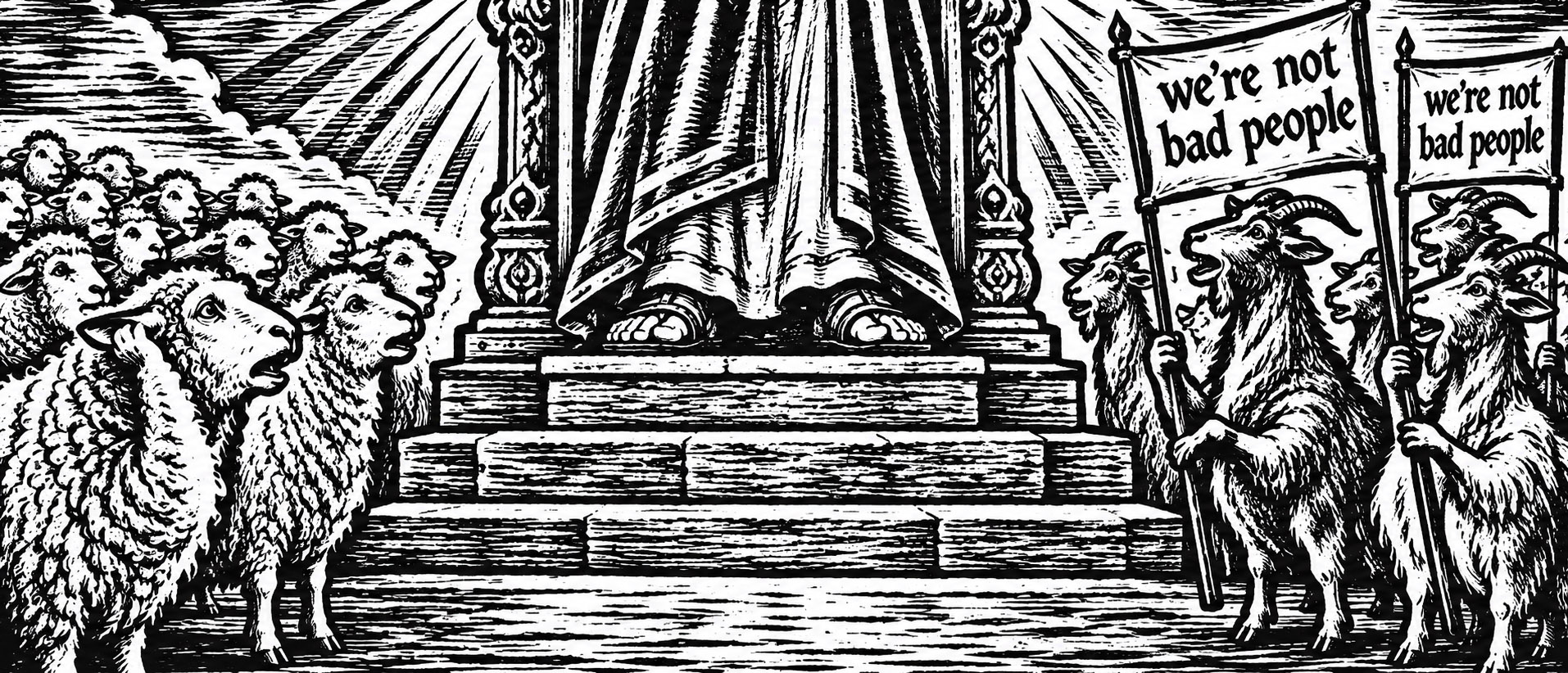
The “goats” – well, they couldn’t give a toss.
Indeed, the “goats” might gather under the banner of “we’re not bad people”. A bit like the man who came to me once and said he’s just flown , for fun all over Europe in a week and wanted me to agree: “But that’s all right isn’t it?”.
What I said was “Do you think it is ?”
Goats? – they don’t even need to be the most obvious, direct, intentional cause of the danger or injustice, or the violation of the planet: simply, they ignore it. Even when they see it.
Though in our day you begin to earn your horns by joining Trump in saying climate change is a hoax, or by voting for a fascist party who long to persecute refugees and destroy anything the slightest bit sheepish.
And because Creation IS connected, the tragedy for them – according to the story – is that they add to their own demise. As well as that of others.
Being unresponsive, disconnected, unwilling to leave their comfort zone to help, they actually endanger themselves, and their world. In reality.
Not just fantasy. A folktale, but not unreal.
Just, indeed, as to love your neighbour as yourself is, rationally speaking, the only way to love yourself.
The way Jesus describes it – though I don’t think the Bible translations of the last century have brought this through – the unified, bottle-garden Creation with which our faith – and indeed our species – is most concerned, the sky and soil of Planet Earth – are always connected and interactive.
This isn’t a novelty: it builds on Old Testament stories like that of Jacob’s Ladder, emphasising the constant interchange between all parts of the terrestrial Creation. And indeed, the conversation which begins the Book of Job, where Satan turns up at God’s committee meeting to manage Creation.
What you do in one affects the other.
We’ve got to be very careful that we don’t mistake the poetry of the Bible, which does relate to reality, for a fantasy which has no obligation to do so.
All the more in our day when we’re connected by machinery which gives the illusion of being completely disembodied.
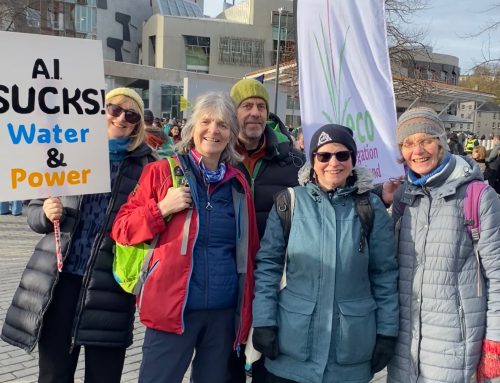
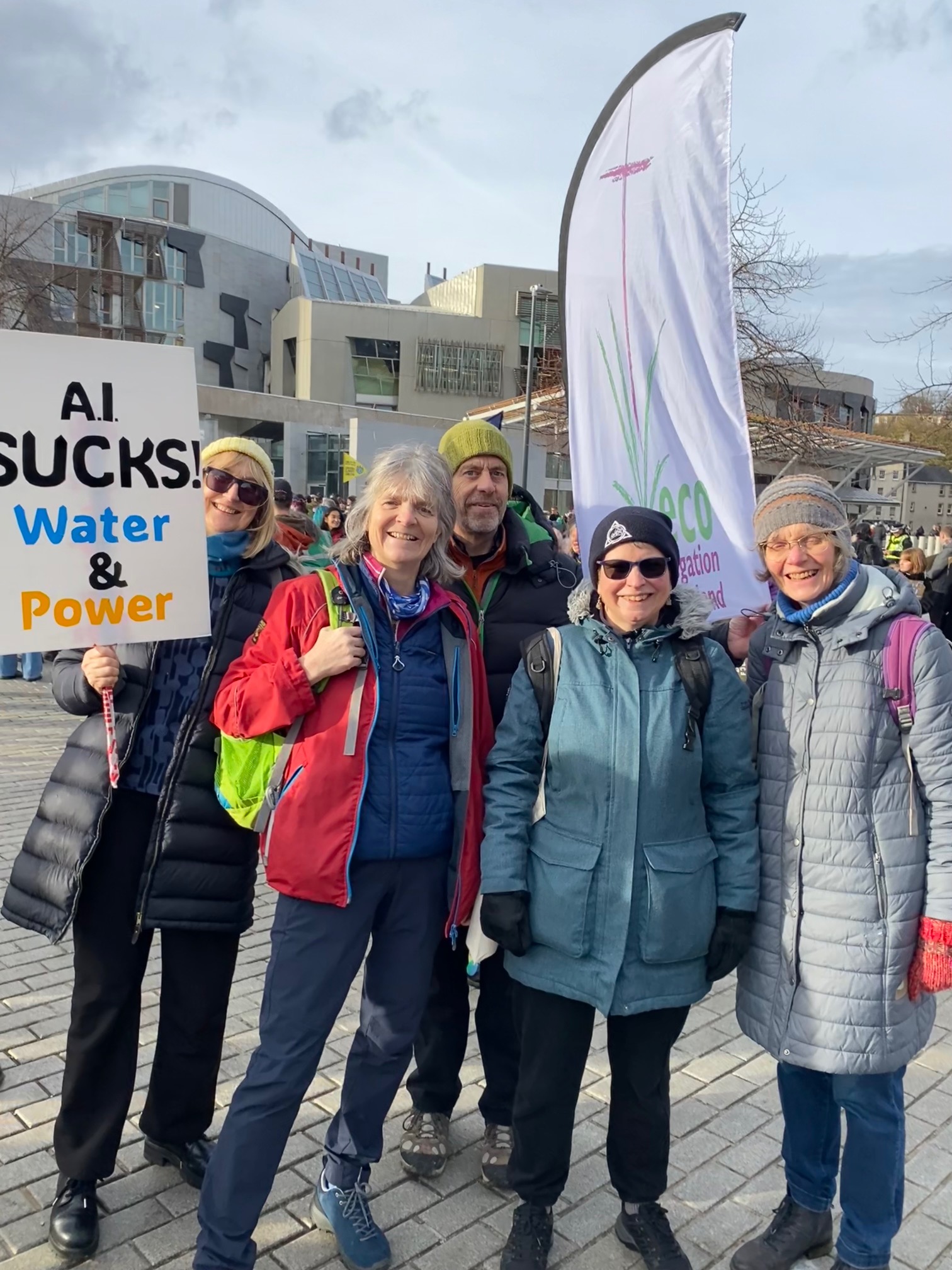
When it feels like we’re receiving our communication and entertainment out of thin air, but there are very real, noisy and polluting data centres, already, and in planning, which undermine so many of our initiatives for clean air and sustainable energy.
There is no air so “thin”, that anything at all vanishes into it. The ancient statements of belief of the church encourage believers to see God as the maker of realities “seen and unseen”, not real and unreal.
Taking note of creation beyond the merely human gently teaches us much about that.
Leading a week on Iona, we put out a moth trap each night, and every morning, came face to face with creatures who surround us all the time, even if we don’t notice. Or we might just be looking the wrong way.
But this is also why, in the work I do with churches, let’s say, I preach the complete opposite of that over-rated first line by John Lennon: not “imagine there’s no heaven” but rather “when you imagine heaven, remember you’re talking about reality”.
Just look up – the sky’s still there isn’t it? – or it was when I came in.
And stories – especially those in the folk-tale mode of what we read today – Bible stories are a wonderful spiritual resource for difficult times, for people under pressure. The more I discover about the state of the world, the more I value them accordingly.
The last Sunday before Advent, as I noted early in my time in ministry, is often called Christ the King Sunday. It’s a name which of course raises some hackles. And some rather prefer “Reign of Christ”. With good reason, for both in the Bible and in subsequent history, monarchs really do not have the greatest reputation for equity and righteousness. Indeed, they have often had difficulty telling the difference between their will and God’s.
It’s rather clearly been the ambition of a certain President to behave like one of these obsolete tyrant kings, ruling by whim rather than wisdom, looking to God only as a faithwashing excuse.
I learned that word in a conversation at the Vatican a couple of years ago – where they’re deeply concerned at how unjust leaders, be it of nations or, more powerfully, mineral corporations, love to add the blessing of the Church to their armoury of deception and oppression.
That’s what kings, and the robber-barons of capitalism tend to do.
Why would we want to approach Jesus in this way, who honoured the disciples by calling them friends -rather than servants or slaves, – why would we honour him with such a widely discredited title, even if, now we do actually have a king in the UK -though as a constitutional monarch, whose family, at their best, plants trees and safeguards traditional skills, caring with a genuine passion for Creation in a way elected representatives seem unable, or unwilling to do.
I’ve seen, at the King’s Foundation, some of the very positive projects he’s quietly got moving in an area of high unemployment; but as far as the common people of the world are concerned, that’s very much the exception, rather than the rule.
There are places and times where people with titles do some good- as I’ve seen when preaching at Roslin Chapel, which might not be in use as a church if it were “just an ancient monument”.
But by and large, a king is your enemy, unless he’s going out of his way to prove otherwise.
And so, all that said, when I look at how this special Sunday emerged in the early twentieth century, the background is precisely as a protest against corrupt and violent rulers, who more often than not appeal to religion for a justification. In the confident hope that there’s no authority they’re responsible to.
And yet in this amazing bit of apocalyptic poetry, it comes as so much of a surprise both to the righteous and the unrighteous that their habitual ways of life, the attitudes reflected in how they treat those in need are what determines their own fate.
Middle-eastern sheep and goats, I’m told, are pretty difficult to tell apart without specialist knowledge. They probably can’t tell themselves, though they do not successfully interbreed. The distinction is not with race or class or gender or wealth or ability, but with the choices we make.
In the work I’ve been doing this year, I’ve seen that the gift of faith is a vision of connectedness. Which really shouldn’t be a surprise for Christianity, based on the God’s flesh and blood connection, incarnate in the Earth as Jesus. The saints are the communities who connect, the Devil and all his angels [messengers] are those who isolate, who spread the lies that actions and choices have no further consequences.
These are your enemies; these are the ones who endanger you: the ones who say “chuck it away, drill baby drill, fleece the poor, trample the weak, burn and burn and burn as” if your rubbish simply vanished into non-existence. The ones who say
“charity begins at home…. and damned well stops there”.
Who entrap us with apathy, who enslave us with despair.
Who make of us goats when we can be sheep. Yes, still we can choose.
Maybe, when the music stops, you’re a habitual goat who’s sneaked over to the sheep. Who’s going to be bothered. And then, we become. by the grace of God kings and queens ourselves, or something rather better.
It’s a story, a folktale. With a sharp edge to wake you up before it’s too late. But it’s real too. Like the sign at the edge of a cliff. And that’s Good News.