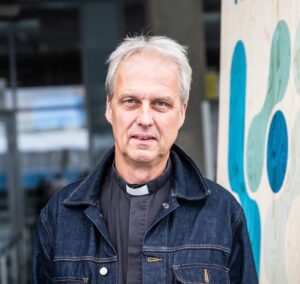
Rev. Henrik Grape
Guest blog
Rev. Henrik Grape, Senior Advisor on Care for Creation, Sustainability and Climate Justice at the World Council of Churches, is at Cop31 in Türkiye. A veteran of many such meetings, he reflects here on whether the discussions at this year’s conference are all worth it. Despite the difficulties, he believes the chance for NGOS and those countries worse affected by climate change to be heard remains vital.
COP31 will not go down in history as the COP at which major progress was made. Perhaps it will go down in history as the COP with the largest number of accredited participants. Between 70,000 and 100,000 people have been given the opportunity to receive a small plastic card on a lanyard to wear around their necks, displaying their name and the organisation they represent at COP.
One has to ask whether it is worth it. And I am not thinking about all the air travel it has generated. Far more people still fly every year for leisure. But is it worth bringing together the countries of the world and groups from civil society for twelve days of negotiations, side events and meetings?
After all these years of being part of the COP circus, I am inclined to say yes. Where else is there a platform where everyone can be represented and has the opportunity to make their voice heard? I cannot think of one.
The 80 years that have passed since the founding of the United Nations have brought enormous changes. At the same time, 80 years means that the collective memory of why the UN was created has begun to fade.
“Never again war” was the slogan after the First World War. But that failed, and after the Second World War the rallying cry became more about “Never again” in reference to the Holocaust, fascism, genocide and large-scale conflicts. It was out of this commitment to “Never Again” that the United Nations was born. But perhaps the collective memory of a generation only lasts for 80 years. And when that memory fades, so does our understanding of why institutions such as the UN exist and what purpose they serve.
The 2020s have brought us new authoritarian regimes and an acceptance of war as an instrument of power. (Who has been paying attention to the UN Security Council during the recent wars?) Polarisation is growing, accompanied by winds of values and ideas that we once thought would never return.
The UN Framework Convention on Climate Change was created during a window of opportunity. The collapse of the Soviet Union, the democratisation of Eastern Europe and a belief in global cooperation created possibilities to address threats beyond the military sphere. The growing pressure on ecosystems and its consequences had become increasingly evident, and the world was able to establish conventions on issues such as biodiversity and climate change. This happened at a time when the collective memory of “Never Again” had not yet completely faded.
Since those early years of the 1990s, the world has drifted towards a worse place, and the confidence that we could work together to create a better common future has been severely undermined.
Despite the ever-growing body of knowledge about the impacts of climate change, the activities causing those impacts have continued to expand. A new kind of stupidity has taken hold of the public sphere. It is a stupidity that also protects those with vested interests in preventing measures that would reduce the dangers of climate change. Twenty years ago, climate science denial may have been confined to a small extremist group. Today, when knowledge and data are so much more extensive, this new stupidity allows people to simply say, “I don’t believe in climate science” – and get away with it. This new stupidity has gained a foothold in public discourse and has even taken political power in many parts of the world.
Despite living in an age of climate change, we seem more entrenched in our positions now than when the knowledge first began to reach us. Glacial collapses in Nepal, forest fires in Europe, excess mortality during the heatwaves of the summer of 2026, and so on. But are these events moving us away from the mechanisms driving climate change? No. Are we doing everything we can to reduce our impact and work together to adapt the world to the changes we are experiencing? No.
Sweden, once a frontrunner, is now falling like a stone. This is hardly surprising when subsidies for petrol and diesel are increasing while the proportion of biofuels in transport fuels is being reduced. Are we helping the most vulnerable and poorest countries adapt to climate change? No. Development assistance, including climate finance, is being cut by many wealthy countries, Sweden among them. Now, development assistance is supposed to be based on business principles. There must be profits to be made.
Is any of this being discussed at COP31? Well, among the many civil society participants, it certainly is. Some have become deeply cynical about the state of affairs. Others still hold on to the hope that change is possible. Some have become trapped in a transactional mindset and can no longer see that what we need to address is a challenge of global solidarity, not a matter of securing the best possible deal for ourselves.
There is something rather strange about the amounts being negotiated for various climate-related funds. They may appear substantial, but compared with what was spent on the arms industry over the past year, they are insignificant. Moreover, very few countries actually contribute what they have promised to these funds. And even when the money is made available, it is difficult to know whether it will genuinely reach the places and initiatives where it is most needed.
Still, we can hope that the new stupidity that has spread across the world like a virus will begin to subside. Perhaps this new stupidity needs a new “Never Again”.
Never again will we allow ourselves to be deceived by lies and half-truths.
Never again will we accept political smokescreens and transactional corruption.
Never again will we settle for short-term solutions at the expense of the future.
—————————————————————
World Council of Churches At COP31
For the churches, COP31 is more than a negotiation.
“We reiterate that the ecological crisis is fundamentally spiritual and moral,” the WCC executive committee said on 12 June 2026. The statement says that “the churches are called to participate in God’s work of healing relationships between humanity and the whole Living Planet, among peoples and nations, and across generations.”
Read more about the World Council of Churches at COP31