Dr. Adrian Shaw, ECS board member, and formerly climate change officer at the Church of Scotland, has recently completed a PhD in Theology and Religious Studies at Glasgow University. Here he describes his research and why it is significant for eco-congregations today.
The purpose of my thesis is to explore what Church of Scotland ministers were writing about the natural environment in the late eighteenth century. Examining over 900 parish accounts published in the Statistical Account of Scotland, the thesis analyses ministers’ descriptions of the natural environment, and what they tell us about ministers’ attitudes towards the environment.
The Statistical Accounts was compiled from written contributions by ministers from across Scotland between 1790 and 1797. The parish accounts were written in response to a request sent by Sir John Sinclair to parish ministers after the General Assembly of 1790. Sinclair was a leading politician, a commissioner to the General Assembly, and sufficiently influential to persuade leading churchmen to back his request. Sinclair’s letter to ministers was accompanied by a questionnaire of 160 questions, 60 of which related to the geography and natural history of the parish. Ministers initially responded with limited enthusiasm but, following several reminders, cajoling and some pleading, Sinclair was successful by 1797 in compiling parish accounts for all parts of Scotland. The resulting publication in 21 volumes, the Statistical Account of Scotland, is now freely available online.
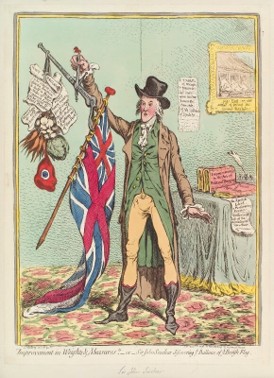
Image courtesy of the National Portrait Gallery, London, under creative commons licence.
The accounts provide an enormous amount of information about Scotland’s environment in an age of rapid change. Agricultural transformation, the growth of coal mining and the development of new industries are all recorded by ministers, as are hundreds of descriptions of woodland, fauna and flora, landforms, rivers, coasts, and the minerals found in their parishes.
The accounts demonstrate that many ministers were interested in the natural environment and its exploitation, and that some were expert. I call such experts ‘minister naturalists’ and believe that they deserve to be better known.
Among the minister naturalists was William Bennett of Duddingston, who listed the aquatic plants of Duddingston loch and who critically assessed the meaning of fossil finds on the coast at Portobello. Robert Rennie of Kilsyth wrote a detailed account on the topography of the parish and its minerals and went on to write a two volume study about the natural history of peat bogs in Scotland. John Stuart at Luss was both a Gaelic scholar (he completed a translation of the Old Testament into Gaelic) and a botanist. He made one of the earliest botanical surveys of Ben Lawers and also made important contributions to John Lightfoot’s Flora Scotica of 1777, the first systematic survey of Scotland’s flora. In his account of the parish of Luss he listed all the species of wild animals, birds and fish found in the parish. The list includes the names of the species in Latin, English, ‘Scotch’ and Gaelic.
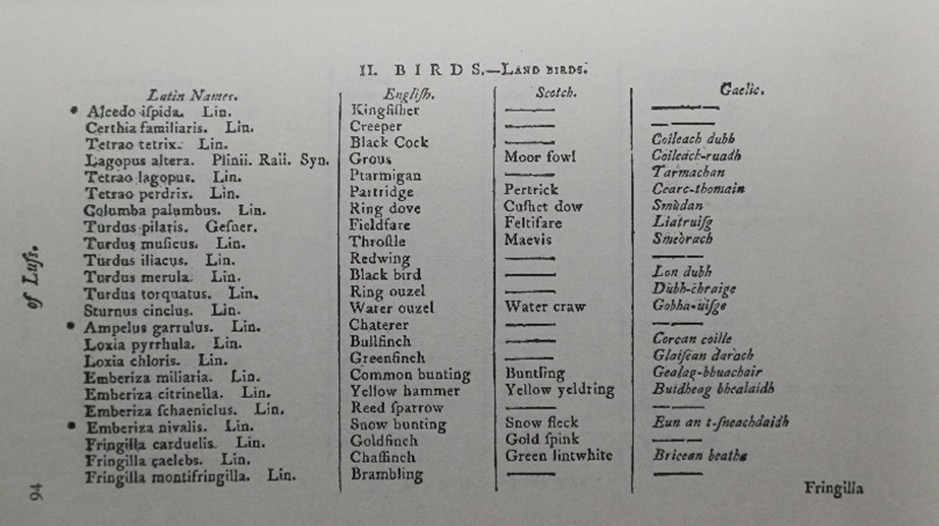
Follow the link to the Statistical Accounts of Scotland
James Meek was minister at Uddingston and Moderator of the General Assembly (1795). His account included meteorological data based on daily observations of the weather at the Manse, from 1785 to 1809. His journal and register of the weather, held in manuscript in Glasgow University Library, is an important source of information for climate scientists researching climate change over the past 200 years.
David Ure, assistant minister at East Kilbride, examined fossils in quarries in the parish and published a book describing the natural history of the parish. His drawings of fossils are some of the earliest in Scotland, for which he has been described as the ‘Father of Scottish palaeontology’.
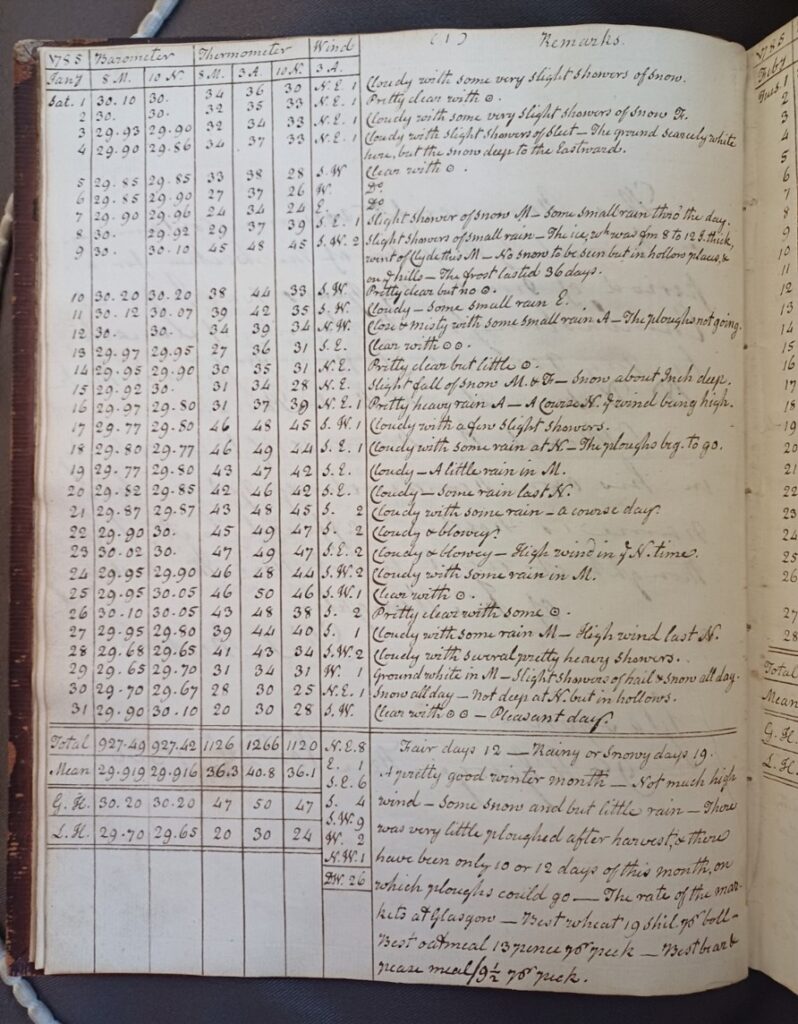
Image reproduced courtesy of University of Glasgow Archives and Special Collections, Manuscripts Collection.
These brief examples are a small proportion of many more ministers who held an interest in the natural environment. An important example of the widespread interest in the natural environment is found in the many accounts of soils in parishes across Scotland. Over 90% of the accounts included a description of the soils in the parish. Ministers were aware of the importance of soil and its good management to successful agriculture, and, in the accounts, they reveal a commitment to the enlightenment ideology of ‘improvement’.
A belief in improvement in agriculture, industry and in the housing , health and wellbeing of their parishioners was almost universal among the clergy. This was in part due to their education. In preparation for the ministry almost all aspiring ministers studied in Scottish universities, where as part of the arts degree they were taught natural history and natural philosophy by professors, some of whom, such has John Walker at Edinburgh and Thomas Reid at Aberdeen and Glasgow, were themselves Church of Scotland ministers. In this education ministers were imbued with enlightenment values, a commitment to ‘improvement’ and to a scientific understanding of the natural environment. They supported agricultural improvement, including the use of new technology such as new ploughs and threshing machines, the enclosure of open fields, creation of new woodland plantation, and the application of mineral fertilisers to the soil such as lime and marl to improve soil fertility.
We now understand that agricultural ‘improvement’ was a mixed blessing for biodiversity. The planting of new woodlands offered a new habitat for some endangered species, like the red squirrel, but the draining of wetlands and intensification of farming reduced other species. Birds of prey were hunted towards extinction with the enthusiastic support of many ministers. While ministers were knowledgeable about the natural world, the great majority were not interested in conservation: improvement was the dominant ideology among them. Likewise, we now understand that the rapid growth of the coal industry resulted in pollution of water, air and land and held long term consequences for climate change.
Why is this important for eco-congregations in the twenty first century? First, it demonstrates that an interest in the natural world by the clergy in Scotland is not new. Ministers from the eighteenth century, and probably earlier, were interested in the natural environment, sometimes passionately so. Second, it is important to recognise that their values were very different from twenty first century attitudes towards the environment. Ministers shared the values of the Scottish enlightenment, embracing ‘improvement’ as an ideal. Both our understanding of the natural environment and some of the environmental problems we now face can be traced back to the attitudes and understanding of ministers in the eighteenth century. Finally, ministers were not critical of science, far from it. When James Hutton argued in1785 that the earth must be of immense, possibly infinite age, in blatant contradiction to any literal interpretation of the bible, ministers did not object. But that is a story for another blog!
The thesis is available to download at Glasgow University Library website => Science, religion and the environment in the old statistical account of Scotland – Enlighten Theses